The Best Paper Planners for 2026: Stop Using Apps to Plan Your Life

It is that time of year again.
You feel the urge. The “New Year, New Me” energy is coursing through your veins. You tell yourself that 2026 will be different. You are going to be organized. You are going to crush your goals.
So, what do you do?
You download a new productivity app. You spend three hours setting up a complex Notion dashboard. You color-code your Google Calendar. You subscribe to a task manager.
And by February 1st, you have stopped using all of them. The notifications pile up. The dashboard becomes a source of guilt, not clarity.
Why does this cycle repeat every single year?
It is not because you lack discipline. It is because you are trying to plan your life in a chaotic environment.
Trying to plan your future on the same device where you watch TikTok and answer emails is like trying to meditate in the middle of a nightclub. It is loud. It is distracting. It is doomed to fail.
Hi, I’m Finn Albar.
I have tried every app under the sun. But three years ago, I switched back to paper. And my productivity didn’t just stabilize; it skyrocketed.
Here is the science behind why your brain prefers analog planning, and the definitive guide to the Best Paper Planners of 2026 for every type of thinker.
Scheduling vs. Planning
We often confuse “Scheduling” with “Planning.” They are not the same thing.
Scheduling is logistics.
Dentist at 2 PM. Zoom call at 4 PM. Digital tools (like Google Calendar) are superior for this. They send reminders. They sync across devices. Keep using them for logistics.
Planning is thinking.
What is my priority today? How do I break down this big project? Who do I want to become? Digital tools are terrible for this. Digital screens trigger a “skim-reading” mode in our brains. We don’t think deeply; we just move pixels around.
Paper forces you to slow down.
When you write a goal by hand, you are engaging in a process called Cognitive Offloading. You are physically transferring the mental load from your brain to the paper. Because you cannot erase or drag-and-drop easily, you have to be intentional. You have to commit.
A paper planner is a contract with yourself. An app is just a suggestion.
Which Planner Fits Your Brain?
In 2026, the paper planner market is flooded with options. Most of them are just pretty notebooks with dates.
But a few are true “Productivity Systems” disguised as books. I have curated the top 4 contenders based on paper quality, layout philosophy, and build durability.
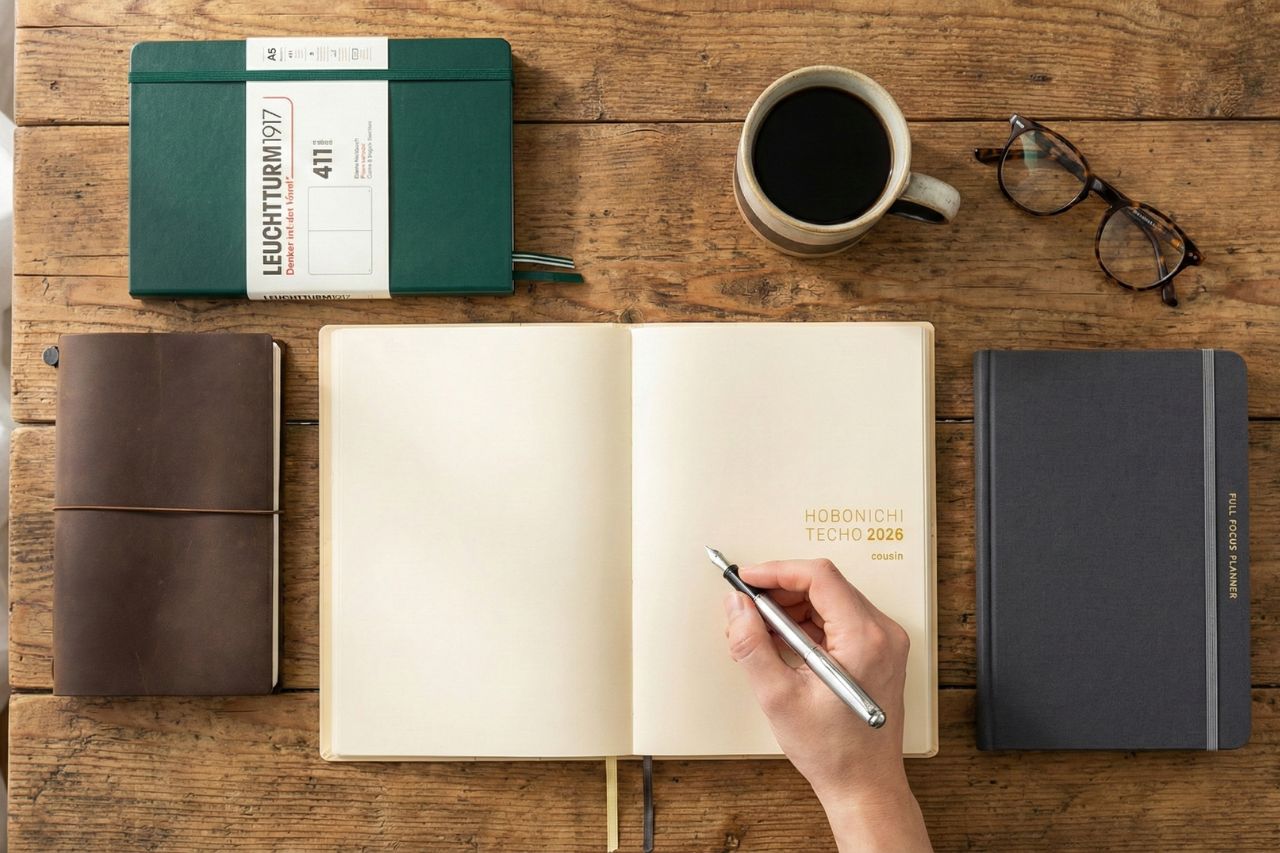
1. The Cult Favorite: Hobonichi Techo
Best For: The creative perfectionist who loves detail.
If you dive into the planner community on YouTube or Reddit, you will hear one name whispered with reverence: Hobonichi.
This Japanese planner has a cult following for one reason: Tomoe River Paper.
This paper is impossibly thin (like Bible pages) yet incredibly resistant to ink bleed. It makes the book feel compact and dense, despite having a page for every single day of the year.
The Layout: The “Cousin” size (A5) offers a unique three-part structure:
- Monthly View: For the big picture.
- Weekly View: Vertical columns for time-blocking your day.
- Daily Pages: A full blank page for every day.
Why It Works:
The grid is faint and unobtrusive. It gives you structure if you need it, but disappears if you just want to draw or write. It is the most flexible planner on this list. It feels less like a “Work Tool” and more like a “Life Companion.”
The Caveat:
It is expensive, and the paper is so smooth that gel pens take a few seconds to dry (smudge alert).
2. The Productivity System: Full Focus Planner
Best For: The goal-oriented executive or entrepreneur.
Most planners are just empty calendars. The Full Focus Planner (created by Michael Hyatt) is a coaching course in book form.
It is designed around a 90-day cycle (you buy 4 books a year). This sounds excessive, but it is strategic. It forces you to reset your goals every quarter.
The Layout:
- The Daily Big 3: Every morning, it forces you to identify the only 3 tasks that actually matter. Not your to-do list of 20 items, just the 3 that move the needle.
- Weekly Preview: A structured guided journaling session to review what went well last week and plan the next.
Why It Works:
If you struggle with Deep Work, this planner is your safety rail. It doesn’t let you get lost in busy work. It constantly asks: “Is this task aligning with your quarterly goal?”
The Caveat:
It is bulky and expensive (since you need 4 per year). It is strictly for work/goals; there is little room for doodling or “vibes.”
3. The Blank Canvas: Leuchtturm1917
Best For: The minimalist who hates pre-made boxes.
We covered this in our Minimalist Bullet Journal Guide, but it deserves a spot here.
Sometimes, a pre-printed planner feels restrictive. What if I don’t have anything to schedule on Saturday? That blank space judges me.
The Leuchtturm1917 is the gold standard for Bullet Journaling. It is just a high-quality notebook with dot-grid paper and numbered pages.
Why It Works: You build the planner as you go.
- Busy day? Use two pages.
- Vacation week? Skip it completely.
- Need to sketch a desk setup? Turn the page and sketch.
It is the ultimate tool for control. You are not filling in someone else’s boxes; you are creating your own structure tailored to your neurotype.
The Caveat:
You have to do the work. If you are lazy about drawing lines or writing dates, this system will fall apart in two weeks.
4. The Lifestyle Aesthetic: Traveler’s Notebook
Best For: The digital nomad and the romantic soul.
The Traveler’s Company notebook (formerly Midori) is barely a planner. It is a beautiful piece of thick leather with an elastic band that holds multiple thin “inserts” (small notebooks) inside.
The Layout:
It is modular. You buy the leather cover once (it ages beautifully over years), and you swap out the insides. You can have a “Monthly Calendar” insert, a “Blank Sketch” insert, and a “Lined Notes” insert all in one bundle.
Why It Works:
It feels like an adventure. Pulling this out at a coffee shop makes you feel like Indiana Jones or a Hemingway-esque writer. It encourages you to take it everywhere. Because it is tall and slim, it fits in a jacket pocket or a small bag easily. The more you beat it up, the better it looks.
The Caveat:
The slim size is awkward for some people to write in (it doesn’t lay completely flat like the Hobonichi).
The Hybrid Workflow
The biggest mistake people make is trying to replace everything with paper.
Don’t do that. You will miss meetings.
Here is the Hybrid System I recommend for 2026:
Digital (Google/Apple Calendar): Use this for “The Landscape.”
- Meetings, appointments, birthdays, travel dates. Things that involve other people and need reminders.
Analog (The Paper Planner): Use this for “The Path.”
- Your daily to-do list.
- Your daily focus.
- Your thoughts and notes.
The Morning Ritual:
Every morning, open your digital calendar. See the “hard landscape” of your day (e.g., meetings at 10 AM and 2 PM). Then, open your paper planner. Write down those meetings. Then, look at the empty space between them. That is where you plan your Deep Work. Write down exactly what you will do in those gaps.
This act of transcribing from screen to paper creates a mental commitment. You are downloading the day into your brain.
Which One Should You Buy?
- Buy the Hobonichi Techo if: You want the highest quality paper on earth and a flexible “one page per day” layout.
- Buy the Full Focus Planner if: You need a boss. You want a rigorous system to force you to hit your revenue or career goals.
- Buy the Leuchtturm1917 if: You want to start Bullet Journaling and want total freedom.
- Buy the Traveler’s Notebook if: You value aesthetics, modularity, and want a planner that lasts for decades.
Final Thought
A planner is not a magic wand. Buying a gym membership doesn’t make you fit, and buying a planner doesn’t make you productive.
It only works if you trust it.
So, pick one. Any one. It doesn’t matter if it’s the “perfect” one. Just pick one, keep it open on your Desk, and use it to defend your time from the chaos of the digital world.