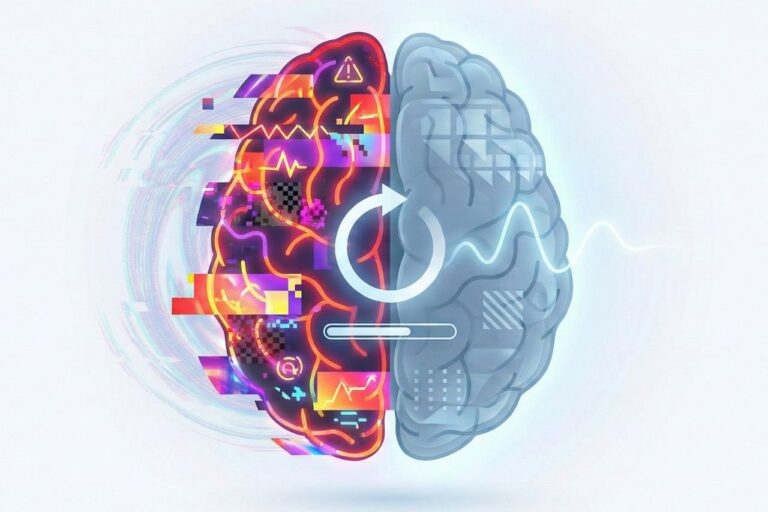
7 Warning Signs You Need a Digital Detox (Checklist)


We all know the obvious feeling of spending too much time online.
You know the one: your eyes feel like they have sand in them, your battery is at 4%, and you realize you’ve been sitting in the same awkward position on the couch for three hours.
That’s physical exhaustion. That’s easy to spot.
But the real danger of digital overload isn’t the physical symptoms; it’s the psychological ones. It’s the subtle shifts in your mood, your focus, and your anxiety levels that creep up on you so slowly, you don’t even notice them happening.
Until one day, you snap at your partner for interrupting your scrolling. Or you realize you haven’t read a single page of a book in six months. Or you feel a profound sense of loneliness despite being “connected” to 500 people online.
If you have been feeling “off” lately but can’t quite put your finger on why, your device might be the culprit.
Through observing patterns in digital behavior and burnout in 2026, we have identified 7 silent signs that your brain is begging for a digital detox—and exactly what to do about them.
1. The “Phantom Vibration” Syndrome
Have you ever felt your phone buzz in your pocket, reached down to check it, and realized two things?
- You have no new notifications.
- Your phone wasn’t even in your pocket; it was on the table across the room.
This is called Phantom Vibration Syndrome, and it’s a very real psychological phenomenon.
It happens because your brain has become hyper-vigilant. You have trained your nervous system to be on high alert for the next dopamine hit—a like, a message, an email. Your brain is so desperate for that connection that it starts hallucinating sensations just to get you to check the device.
It’s a sign that your baseline anxiety levels are elevated. You are constantly in a state of “waiting” for something to happen, rather than being present in the moment.
The Micro-Fix:
Turn off all non-human notifications. If an app sends you a notification that wasn’t written by a real human being (e.g., “Check out this reel!” or “Your troops are ready for battle”), turn it off. Train your brain that a buzz implies a genuine connection, not a marketing algorithm.
2. The “Goldfish” Attention Span
Be honest with yourself: Can you watch a full movie without checking your phone?
If the movie gets slightly slow for 30 seconds, do your fingers instinctively reach for your device? Do you watch Netflix with your phone in your hand (the “Second Screen” habit)?
Or worse, do you open a new tab on your laptop to search for something, and within the 3 seconds it takes to load, you’ve already picked up your phone to check Instagram?
If this sounds familiar, your attention span has been fragmented. We often joke that humans now have the attention span of a goldfish (about 8 seconds), but it’s actually quite serious. Constant switching between tasks prevents our brains from entering “Deep Work” or deep relaxation modes. We are perpetually skimming the surface of life.
The Micro-Fix:
If willpower isn’t enough to stop you from multi-tasking, use tools. Install an App Blocker like Opal or Forest to lock your phone while you watch a movie or work. Force yourself to single-task.
3. You Doom-Scroll Before You Pee
This is the most common and damaging habit of modern life.
Your alarm goes off. You turn it off. And before your feet even touch the floor, before you’ve had a sip of water, before you’ve said “good morning” to the person sleeping next to you… you are scrolling.
You are checking emails (work stress), reading the news (world stress), or looking at social media (comparison stress).
By doing this, you are letting the outside world hijack your mood before you’ve even had a chance to set your own intentions for the day. You are starting your day in a reactive state (responding to others) rather than a proactive state (creating your own day).
The Micro-Fix:
Banish the phone from the bedroom. “But I use it as my alarm!” is the most common excuse. It is time to buy a dedicated Alarm Clock. Whether it’s a simple Braun analog clock or a smart Hatch Restore, getting the phone out of the bedroom is the single best thing you can do for your mental health.
4. Comparison Anxiety (The FOMO Effect)
You’re having a perfectly okay Tuesday. You’re eating a sandwich. Life is fine.
Then you open Instagram.
Suddenly, you see an old friend on a vacation in Bali. You see a colleague getting a promotion. You see an influencer with a perfectly tidy house and perfectly behaved children.
In an instant, your sandwich tastes like cardboard. You feel inadequate. You feel like you’re falling behind. You feel like everyone else has figured out this “life” thing except you.
This is the Comparison Hangover. Social media is a highlight reel of everyone else’s best moments, while you are living your behind-the-scenes reality. Rationally, we know this. But emotionally, our primitive brains can’t tell the difference. We just feel “less than.”
The Micro-Fix:
Do a “Mute Spree.” You don’t have to unfollow your friends (that might be awkward), but you can Mute them. If someone’s content consistently makes you feel jealous, anxious, or inadequate—mute them. Curate your feed so it inspires you, not drains you.
5. Physical Signs: “Tech Neck” and Eye Strain
Okay, we said this article wasn’t just about eye strain, but we can’t ignore the physical toll completely. The body keeps the score.
- Tech Neck: Do you have chronic pain at the base of your skull or shoulders? That’s from looking down at a 45-degree angle for hours. The human head weighs about 10-12 pounds, but at that angle, it exerts 60 pounds of force on your spine.
- Digital Eye Strain: By 4 PM, do your eyes burn? Do you get headaches behind your eyebrows?
Your body is literally deforming to accommodate your technology.
The Micro-Fix:
For the headaches, consider using Blue Light Glasses if you work in front of a computer all day. For the neck, try to hold your phone at eye level. It looks ridiculous, but your spine will thank you.
6. The “Just One Quick Check” Loop
You unlock your phone to check the weather. 20 minutes later, you are watching a video of a guy building a swimming pool in the jungle. You lock your phone. And then you realize… you never checked the weather.
This is the ultimate sign that you have lost control. The algorithms designed by the smartest engineers in Silicon Valley are working exactly as intended. They are designed to hook you the moment you enter, leading you down a rabbit hole of content you didn’t ask for.
When you lose the ability to use your tool for a specific purpose and instead get used by the tool, you need a detox.
The Micro-Fix:
If this happens daily, software tweaks might not be enough. You might need to change your interface. Consider installing a Minimalist Launcher on Android to hide those colorful icons that trigger the loop.
7. Your Real Hobbies Are Gathering Dust
Look around your room. Is there a guitar you haven’t played in months? A stack of books on your nightstand that remains unread? A sketchbook that’s empty? Running shoes that are gathering dust?
We often tell ourselves, “I’m just too busy. I don’t have time for hobbies anymore.”
But then we spend 3 hours a day on our screens. That’s 21 hours a week. That’s a part-time job!
The truth isn’t that we don’t have time; it’s that we don’t have mental energy. Passive consumption (scrolling) is easy. Active creation (hobbies) requires effort. When our brains are fried from digital overload, we choose the path of least resistance.
The Micro-Fix:
The “Replacement” Strategy. Don’t just stop scrolling; start doing something else. Check out our list of 10 Analog Hobbies to Replace Scrolling. Pick one, and commit to doing it for just 15 minutes a day.
Don’t Panic, Just Pause
If you nodded your head to more than three of these signs, don’t beat yourself up. You are not broken. You are just living in a world designed to distract you.
The solution isn’t to throw your smartphone in the river. The goal is to find a balance.
You need a Reset.
You don’t need a 30-day silent retreat. Start small. Try a 24-Hour Micro Detox this weekend. Or simply commit to keeping your phone out of the bedroom tonight.
Your brain is resilient. Give it a little bit of silence, and you’ll be amazed at how quickly your focus, creativity, and happiness return.
Let’s press pause together.