Best Compact Cameras to Replace Your iPhone in 2026

The smartphone destroyed photography.
That sounds dramatic, I know. Technically, the iPhone 17 takes incredible photos. It has AI processing, night mode, and instant sharing.
But it also killed the soul of photography.
When you take a photo with a smartphone, you aren’t just capturing a memory. You are interrupting the moment. You snap the photo, and instantly, a notification pops up. You check WhatsApp. You wonder if this photo is “Instagram-worthy.” You take 50 more shots of the same sunset, just to be sure.
Instead of experiencing the moment, you are processing it for an audience.
If you are trying to switch to a Dumbphone or just want to use your smartphone less, you face a dilemma: “How do I capture memories without my phone?”
The answer is the return of the Premium Compact Camera.
In 2026, dedicated cameras are having a massive resurgence. Not because they have more megapixels, but because they have a specific purpose. They don’t have email. They don’t have TikTok. They just take photos.
Here are the best compact cameras to help you separate your memories from your distractions.
1. The “Vibe” King: Fujifilm X100VI
Best For: The aesthetic lover who wants “Film Look” straight out of the camera.
If you have been on the internet lately, you know this camera. It is perpetually sold out for a reason.
The Magic:
The Fujifilm X100VI is famous for its Film Simulations. With an iPhone, your photos look clinically perfect (and boring) until you edit them in VSCO. With the Fuji, you dial in a setting (like “Classic Chrome” or “Reala Ace”), and the JPEG that comes out looks like a finished, nostalgic memory.
Why It Replace the iPhone:
- Tactile Joy: It has real dials for shutter speed and aperture. It feels like a mechanical tool, not a computer.
- No Editing Needed: Because the photos look so good instantly, you spend zero time editing on your computer. You just snap and keep.
- The Hybrid Viewfinder: You can look through a glass window (optical) or a screen (electronic). Looking through glass connects you to the real world.
The Trade-off: It is expensive (~$1,600) and slightly heavy to put in a jeans pocket. You need a jacket pocket or a strap.
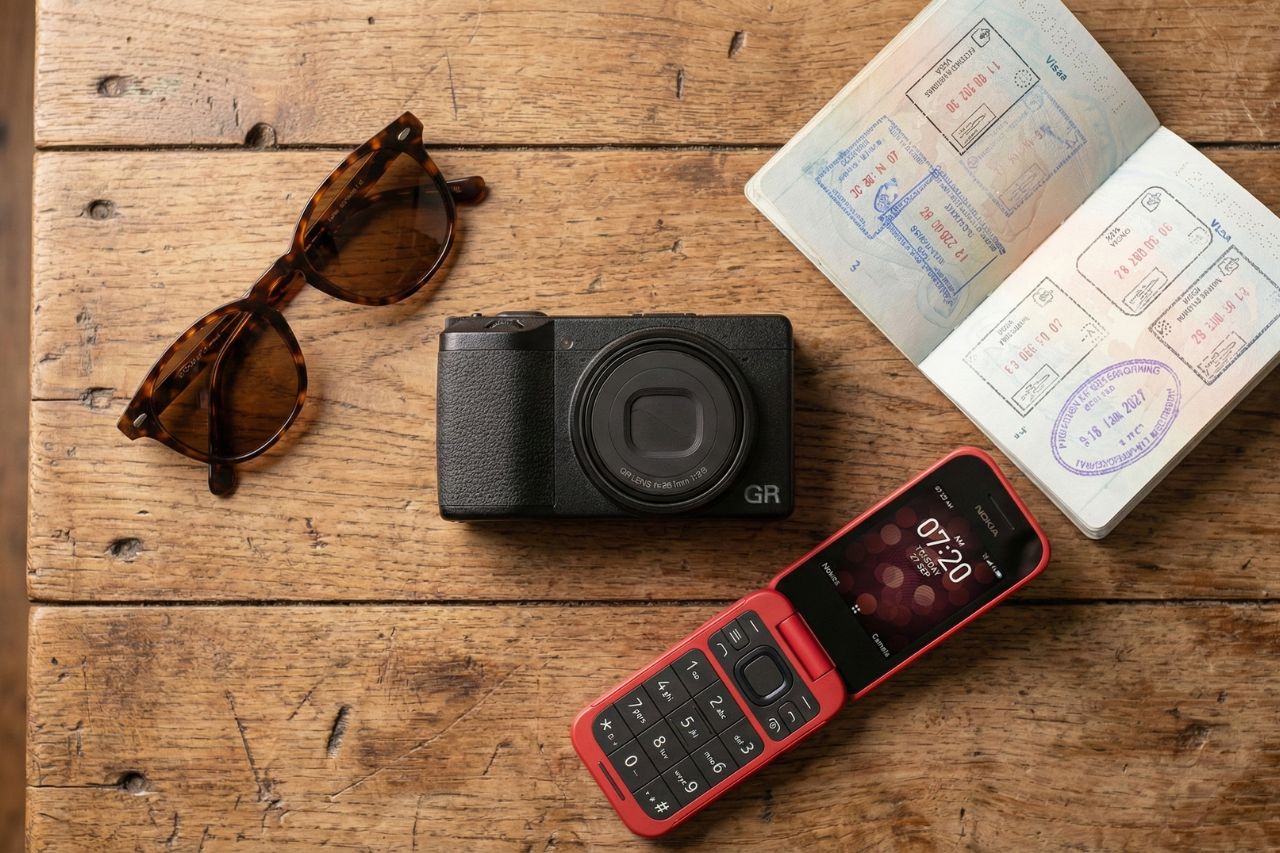
2. The Street Ninja: Ricoh GR III / IIIx
Best For: The minimalist who wants DSLR quality in a pocket size.
This is the cult favorite of street photographers globally. It is smaller than an iPhone, but it has a massive APS-C sensor (the same size as big professional cameras).
The Magic:
It is the ultimate “Stealth Camera.” It turns on in 0.8 seconds. You can operate it entirely with one hand. It has a feature called “Snap Focus”: You can tell the camera to always focus at 2 meters. This means you don’t wait for autofocus. You just point and shoot.
Why It Replace the iPhone:
- True Pocketability: It disappears into any pocket. It is always with you.
- Black & White Mode: The “High Contrast B&W” mode produces gritty, emotional images that make an iPhone look flat.
- Zero Distraction: The battery life isn’t great, which forces you to be intentional. You don’t spray and pray; you compose.
The Trade-off: No viewfinder (you look at the screen). No flash. Battery life is weak (buy extras).
3. The Toy Camera: Paper Shoot Camera
Best For: The radical minimalist who wants a true “Digital Detox” experience.
What if you want the experience of a disposable film camera, but without the cost of developing film? Enter the Paper Shoot.
The Magic: It is a digital camera board sandwiched between two pieces of heavy cardstock (stone paper).
- No Screen: You cannot see the photo you just took.
- 18 Megapixels: The quality is surprisingly decent, resembling vintage film.
- Simplicity: One button. Click. Done.
Why It Replace the iPhone:
This is the best companion for a Light Phone II. Because there is no screen to review your photos, you stay in the moment. You take the shot and put the camera away. You only see the results when you plug the SD card into your computer at home. It brings back the “surprise” of photography.
The Trade-off: Low light performance is bad. It feels fragile (though it’s durable). It is a “fun” camera, not a “pro” tool.
4. The Vlogger’s Choice: Sony ZV-1 II or Canon G7 X Mark III
Best For: Parents and travelers who shoot video.
Let’s be honest: iPhones shoot amazing video. If you are replacing your phone, you need something that can handle 4K video of your kids or your travels without shaking.
The Magic:
These cameras are designed for video first. They have flip-out screens so you can frame yourself or low-angle shots. They have excellent microphones built-in.
Why It Replace the iPhone:
- Optical Zoom: Unlike the digital zoom on phones (which crops the image), these have real lenses that zoom in without losing quality.
- Separation of Church and State: By recording memories on a dedicated camera, you don’t drain your phone battery, and you don’t get interrupted by texts while filming your child’s birthday.
Separate the “Capture” from the “Consumption”
The reason we recommend buying a dedicated camera in 2026 is psychological, not just technical.
When you use an iPhone: Capture -> Edit -> Share -> Check Likes. It is one continuous loop of dopamine seeking. The photo is just bait for engagement.
When you use a Dedicated Camera: Capture -> …… (Time Delay) …… -> View on Computer -> Archive. The loop is broken. The act of taking the photo is for you, for the memory.
You become an observer of the world, not a content creator.
Which One Should You Buy?
- Buy the Fujifilm X100VI if: You have the budget and want the most beautiful photos of your life with zero editing. It is a fashion statement and a powerhouse.
- Buy the Ricoh GR III if: You want speed and portability. You want to capture daily life without being noticed.
- Buy the Paper Shoot if: You are on a budget ($120) and want to break the habit of “chimping” (checking every photo immediately).
- Buy the Sony ZV-1 II if: Video is your priority.
Stop viewing your life through a screen that also holds your email. Get a real shutter button. The sound of the “click” alone is worth it.