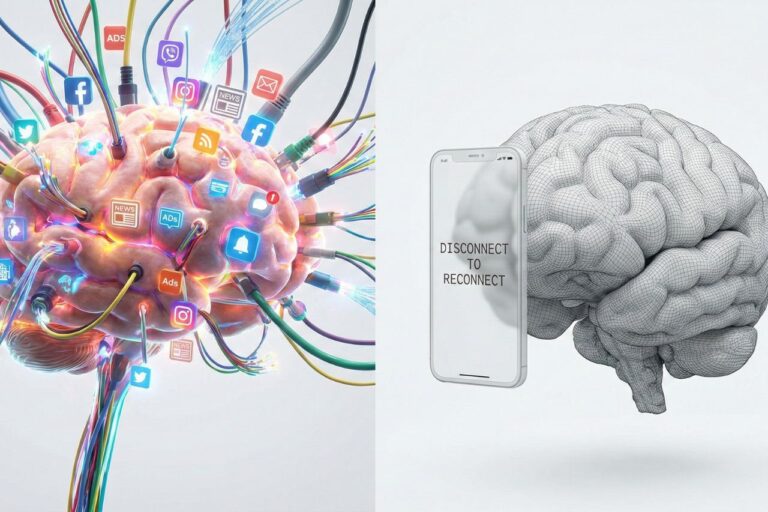
Deep Work 101: How to Focus Without Distraction in 2026


We have confused “Busyness” with “Productivity.”
In the modern office (remote or in-person), the person who replies to Slack messages instantly is seen as a “good worker.” The person who attends six Zoom meetings a day is “working hard.” The person with 20 tabs open is “multitasking.”
But let me ask you: At the end of that chaotic 8-hour day, did you actually create anything of value? Or did you just move information around?
If you feel exhausted but unproductive, you are stuck in the trap of Shallow Work.
The antidote is a concept coined by Cal Newport called Deep Work. In 2026, where AI can automate almost all Shallow Work, the ability to do Deep Work isn’t just a nice skill to have—it is the only skill that keeps you employable.
Here is the no-nonsense guide to mastering focus in a distracted world.
What is Deep Work?
Deep Work is the ability to focus without distraction on a cognitively demanding task. It’s when you push your brain to its limit to create new value, improve a skill, or solve a complex problem.
Shallow Work is non-cognitively demanding, logistical-style tasks, often performed while distracted. Examples: Checking email, replying to Slack, formatting a document, scheduling meetings.
The math is simple:
- Shallow Work prevents you from getting fired (maintenance).
- Deep Work gets you promoted (creation).
The problem is that our entire digital environment is designed to keep us in the shallows. We are constantly interrupted by pings, rings, and buzzes. And once interrupted, it takes about 23 minutes to get back into the “Flow State.”
The 4 Philosophies: Choose Your Style
You cannot do Deep Work for 8 hours straight. Your brain will fry. You need a structure. Cal Newport outlines four approaches. Pick the one that fits your life.
1. The Monastic Philosophy (Hardcore)
You cut yourself off from the world completely. No email, no social media, no phone. You disappear into a cabin (or a quiet room) for weeks to finish a project.
Who it’s for: Fiction writers, researchers, or people with zero day-to-day obligations. (Likely not you).
2. The Bimodal Philosophy (The Split)
You split your time into clear blocks. For example, 4 days a week you are “Open/Shallow” (answering emails, meetings), but 1 day a week you disappear into Deep Work. Or you work deeply from 8 AM to 12 PM, and then open your email for the rest of the day.
Who it’s for: Professors, Managers, or Freelancers.
3. The Rhythmic Philosophy (The Habit)
This is the best one for beginners. You create a daily rhythm. “Every morning from 6:00 AM to 7:30 AM, I write.” By making it a daily habit at the same time, you remove the friction of deciding when to focus. It becomes muscle memory.
Who it’s for: Parents, Office Workers, Students.
4. The Journalistic Philosophy (The Opportunist)
You seize Deep Work whenever you can get it. A meeting got canceled? You immediately switch into focus mode for 30 minutes.
Who it’s for: Busy executives or parents who can’t control their schedule. (Warning: This requires high mental willpower).
How to Execute a Deep Work Session
You’ve chosen your time slot. Now, how do you actually do it? You need a ritual.
Step 1: Define the “Wildly Important Goal”
Don’t just sit down and say “I will work.” Be specific.“I will write 1,000 words of the new report.””I will code the login feature.” Ambiguity is the enemy of focus.
Step 2: Build the Fortress (Remove Friction)
- Phone: Put it in another room or turn on a strict Focus Mode.
- Computer: Close Slack and Email. Use an App Blocker like Freedom to block the internet if you don’t need it.
- Environment: Put on noise-canceling headphones. Signal to others that you are unavailable.
Step 3: Embrace the Boredom
In the first 15 minutes, your brain will resist. You will feel an itch to check your email. You will feel bored. Do not give in. This boredom is the “Warm Up.” Just like lifting weights feels heavy at first, thinking deeply feels hard at first. Push through the resistance, and you will eventually enter Flow.
Step 4: The Shutdown Ritual
When the time is up, stop. Even if you are in the middle of a sentence. Cal Newport suggests a “Shutdown Ritual” where you review your tasks, close your laptop, and say a phrase (like “Shutdown Complete”) to signal to your brain that work is done. This allows you to relax guilt-free in the evening.
The Toolset: Gear for Deep Work
While Deep Work is a state of mind, certain tools help induce it.
- Analog Tools: A physical notebook or a Leuchtturm1917 helps you plan your session without looking at a screen.
- Single-Purpose Tablets: Devices like the reMarkable 2 are excellent because they allow you to think and draft without the possibility of a pop-up notification.
- Timers: Use a simple kitchen timer or a “Time Timer” visual clock. Seeing time physically pass adds a sense of urgency.
Verdict: Focus is the New IQ
In an economy of distraction, the ability to focus is a superpower.
While everyone else is busy replying to emails within 30 seconds, you are building the things that actually matter. You are writing the book, building the product, or learning the hard skill.
Deep Work is hard. It is draining. But it is also incredibly satisfying.
Tomorrow morning, try it. Block out 90 minutes. Close the tabs. Put the phone away.
Go deep.