WFH Burnout: How to Separate “Work” From “Leisure” When Your Home is Your Office

The dream was simple.
No commute. No dress code. The freedom to work from anywhere. In 2026, millions of us have achieved this dream. We are Digital Nomads, Remote Workers, or Hybrid Employees.
But for many, the dream has quietly turned into a trap.
Instead of “working from home,” we feel like we are “sleeping at the office.” Because the laptop is always on the dining table, the work never truly ends. You answer emails at 9 PM because you can. You check Slack while cooking dinner. The boundary between “Productive Time” and “Rest Time” has dissolved into a grey sludge of semi-work.
A 2025 study published in Annals of Tourism Research calls this the challenge of “Border Management.”
Researchers Rainoldi, Ladkin, and Buhalis studied how digital nomads manage the intersection of work and leisure. They found that without strict, intentional boundaries, the “freedom” of remote work leads directly to burnout and the inability to enjoy life.
Hi, I’m Finn Albar.
I spent two years working remotely from cafes and Airbnbs. I thought I was free, but I was actually a prisoner of my own lack of structure.
Here is the science of why WFH makes it hard to switch off, and the 3-step protocol to reclaim your home from your job.
The “Always-On” Trap
Why is it so hard to relax when you work 5 feet from your bed?
The study highlights a concept called Sociomateriality. Basically, objects and spaces hold “scripts” for our behavior.
- In an office, the desk says “Work.” The exit door says “Done.”
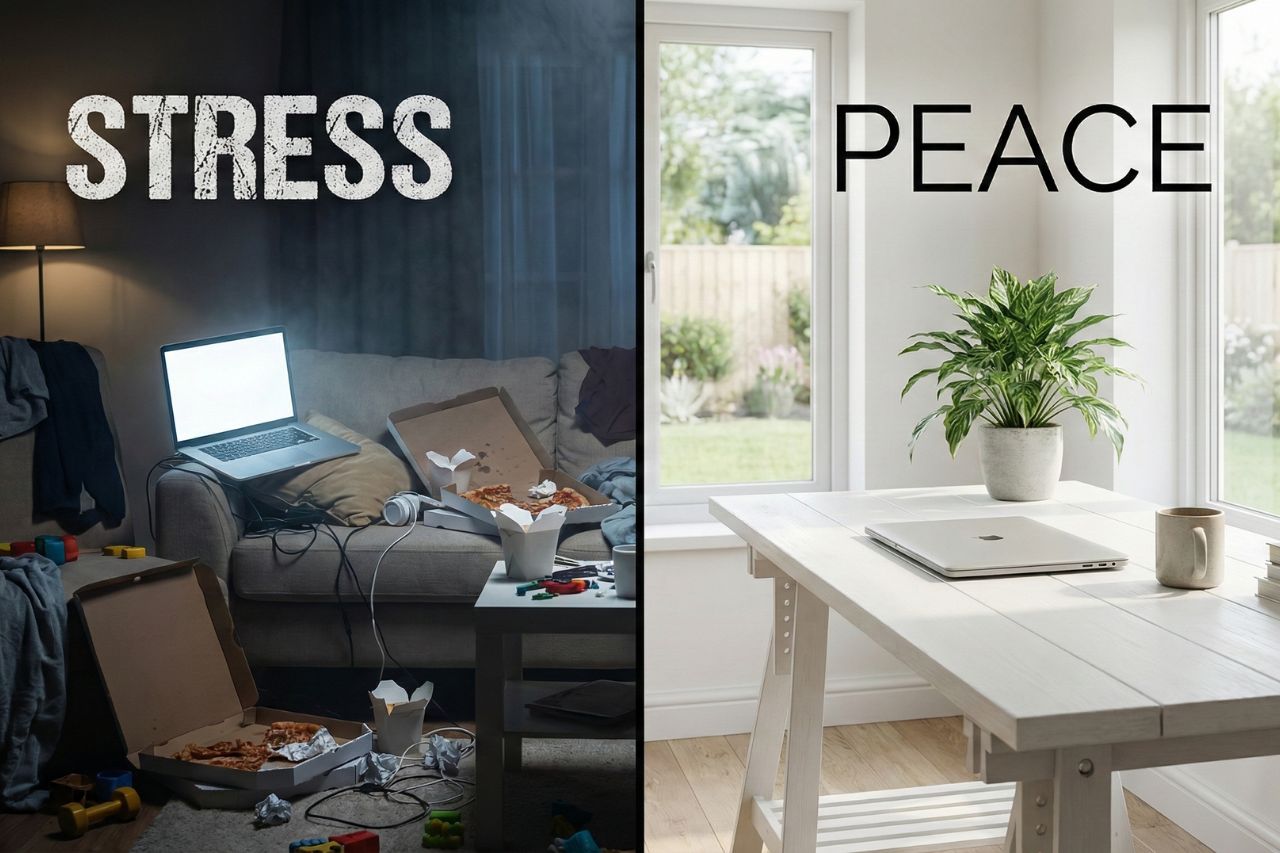
- At home, if you work from your sofa, the sofa no longer says “Relax.” It says “Work.”
When you blur these spatial lines, your brain loses its Context Cues. It remains in a state of low-level hypervigilance, waiting for the next notification, even when you are trying to watch a movie.
This leads to what the researchers call a failure of Psychological Detachment. You physically stop typing, but your brain never logs off.
Strategy 1: The “Fake Commute”
The biggest loss in the WFH era is the commute. We hated traffic, but the commute served a vital psychological function: it was a Decompression Chamber. It gave your brain 30 minutes to switch from “Employee” to “Human.”
You need to build a “Fake Commute.”
The Protocol:
- Morning: Before you touch your laptop, leave the house. Walk around the block for 15 minutes. Get coffee. When you walk back in the front door, you have “arrived at work.”
- Evening: When the workday ends, close the laptop. Put on your shoes. Walk around the block again. When you return, you are “home.”
It sounds silly, but this physical movement signals to your brain that the state has changed.
Strategy 2: Physical Segmentation
The study by Rainoldi et al. emphasizes the importance of Spatial Boundaries.
If you live in a small apartment, you might not have a dedicated office. But you must have dedicated “Work Zones” and “Sanctuary Zones.”
The Golden Rule: Never, ever work from the bed or the sofa.
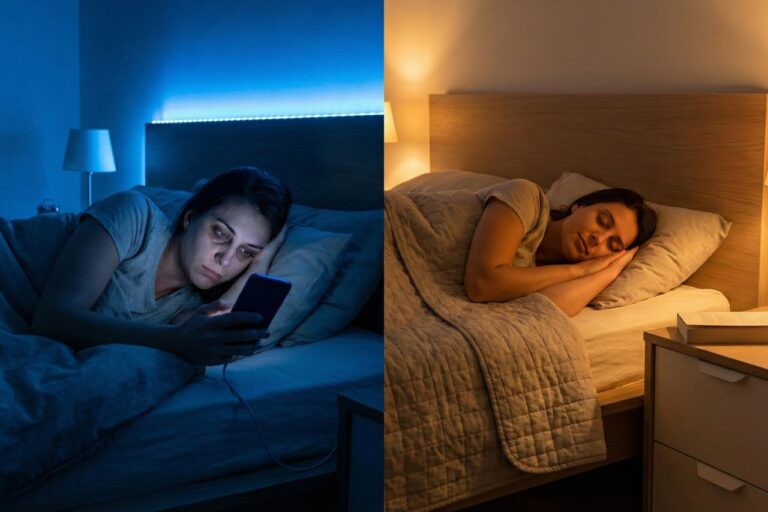
- The Bed: Is for sleep (see our guide on Screens and Insomnia). If you bring a laptop here, you associate the pillow with stress.
- The Sofa: Is for leisure.
Action: Buy a small Minimalist Desk. Even if it is tiny. Work happens only there. When you step away from that square meter of space, work ceases to exist.
Strategy 3: The “Shutdown Ritual”
In an office, you turn off the lights and lock the door. In the digital world, you need a digital lock.
The concept of “Deep Work” requires an end point. As Cal Newport argues, you cannot recover if you don’t fully disconnect.
The 5 PM Shutdown Ritual:
- Close all tabs. Do not leave them open for “tomorrow.” That is cognitive clutter.
- Quit the apps. Don’t just minimize Slack/Teams. Command+Q them. If the dot is under the icon, you are still at work.
- The Final Review: Write down the 3 priorities for tomorrow on a physical piece of paper (or your Bullet Journal).
- The Mantra: Say it out loud: “Shutdown Complete.”
This ritual creates a “Cognitive Closure.” It tells your brain that it is safe to stop worrying about tasks until tomorrow morning.
Final Verdict: Freedom Requires Discipline
The paradox of remote work is that to be free, you must be rigid.
If you want the freedom to enjoy your evening, you must have the discipline to defend it. You are not a bad employee for logging off. You are a sustainable one.
Your home is your sanctuary. Stop letting your boss live there rent-free.
Further Reading

Rainoldi, M., Ladkin, A., & Buhalis, D. (2025). "Digital nomads' work-leisure management practices." Published in Annals of Tourism Research. Read the study here