Tech Shame: Why Feeling Guilty About Screens Backfires

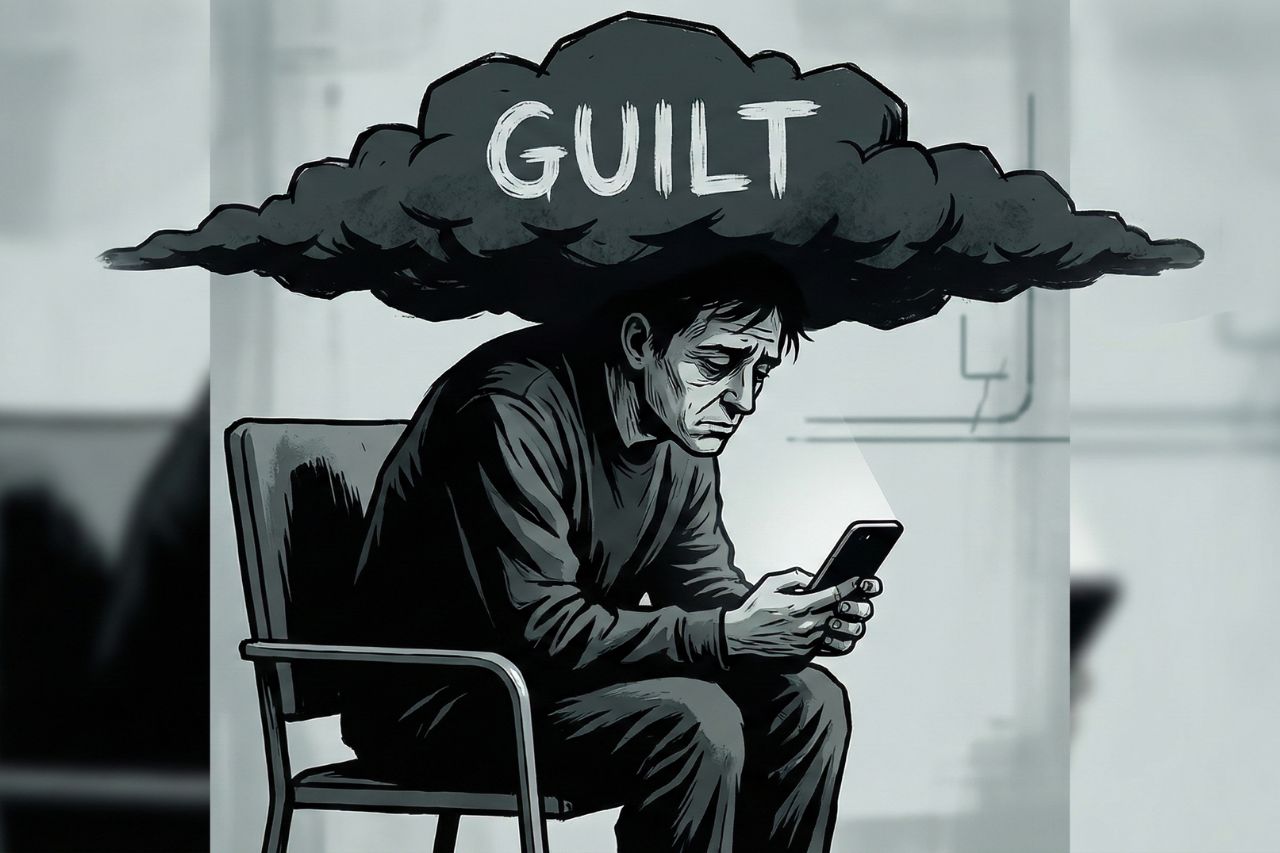
I want you to think about the last time you scrolled through social media for an hour.
How did you feel afterwards? Did you feel relaxed? Did you feel entertained? Or did you feel a heavy, sinking sensation in your chest? Did a voice in your head say: “I am so lazy. I am wasting my life. I am addicted.”
For millions of us, using technology comes with a side dish of Shame.
We have internalized a narrative that screens are “toxic,” “addictive,” and “brain-rotting.” We treat every minute spent online as a moral failure.
But what if I told you that the Guilt is actually more damaging than the Screen?
A provocative new study published in 2026 has uncovered a phenomenon I call “The Tech Nocebo Effect.” It suggests that if you believe social media is destroying your mental health, it will. But if you view it as a neutral tool or a positive resource, your brain processes the experience completely differently.
Hi, I’m Finn Albar.
We spend a lot of time on this blog talking about how to reduce screen time. But today, we need to talk about how to stop beating yourself up when you do use it.
Here is why your mindset might be the real problem, and how to break the cycle of digital shame.
Beliefs Matter More Than You Think
In a study published in the Journal of Affective Disorders, researchers led by Turi Reiten Finserås investigated a crucial question: Does our attitude towards social media influence its impact on our mental health?
They surveyed 3,568 adolescents (a group usually considered the most vulnerable) to measure their “Beliefs about Social Media” against their mental well-being.
The results were striking.
Adolescents who held Negative Beliefs (e.g., believing that social media causes depression or anxiety) reported significantly lower mental well-being and higher somatic symptoms (like headaches and stomach aches).
Conversely, those who held Positive Beliefs (e.g., seeing it as a way to connect or learn) had better mental health outcomes.
The Nocebo Effect
You have heard of the Placebo Effect (believing a sugar pill cures you makes you feel better). The Nocebo Effect is the evil twin. If you believe something will harm you, your body and brain will manifest negative symptoms, even if the substance is harmless.
The study suggests that the constant public narrative that “Social Media is Evil” might be creating a self-fulfilling prophecy. By telling ourselves we are being poisoned, we start to feel sick.
The Cycle of Tech Shame
This research explains the “Shame Spiral” many of us experience.
- The Action: You scroll TikTok for 30 minutes to decompress after work.
- The Belief: You have been told this is “bad for you.” You believe you are damaging your brain.
- The Reaction: You feel guilt. Your cortisol (stress) levels spike. You judge yourself as weak or undisciplined.
- The Outcome: You feel worse than before. Not because of the funny cat videos you watched, but because of the self-flagellation that followed.
We are layering Secondary Suffering (Guilt) on top of a neutral activity.
Why We Demonize Our Tools
Why do we hold such negative beliefs?
The study points out that adolescents are “frequently exposed to portrayals about its potential harms” from parents, teachers, and media.
Society has a history of panicking over new technology.
- In the 1940s, people thought the Radio distracted children from reading.
- In the 1980s, people thought TV would rot our brains.
- In the 2020s, it is the Smartphone.
We treat digital indulgence as a “Sin.” We use language like “Detox” and “Cleanse” (terms borrowed from substance abuse) to describe our relationship with information.
This moralization is unhelpful. It turns a management problem into a character flaw.
Reframing: From “Toxic” to “Tool”
To cure the Nocebo effect, you don’t necessarily need to quit social media. You need to change your Belief System.
You need to move from a Passive Victim mindset (“The algorithm is controlling me”) to an Active User mindset (“I am using this for a purpose”).
The Neutralizer Thought:
The next time you catch yourself scrolling, instead of saying “I am wasting time,” try saying: “I am currently choosing to relax. I am looking for entertainment. When I am done, I will stop.”
By removing the moral judgment, you remove the shame. And when you remove the shame, it is actually easier to put the phone down. Shame drives compulsion; acceptance drives control.
The Role of Content (Again)
This aligns perfectly with our previous discussion on the Feed Cleanse vs Time Limits.
If you believe social media is toxic, maybe it is because your feed is toxic. It is hard to have “Positive Beliefs” about your usage if you are following accounts that make you angry or insecure.
The Finserås study found that “Positive Beliefs” were protective. How do you build positive beliefs? By curating a feed that genuinely adds value to your life. If your Instagram is full of art, Analog Hobby inspiration, and close friends, your brain registers it as a “Good Resource,” not a “Bad Vice.”
Practical Steps to End the Guilt
Here is how to stop the Nocebo Effect from ruining your downtime.
1. Label Your Intent
Before you unlock your phone, state your purpose. “I am going to check Twitter for 10 minutes to see the news.” When you do exactly what you said you would do, you build self-trust instead of self-loathing.
2. Separate “Rest” from “Rot”
There is a difference between intentional rest and “bed rotting.” If you are tired and want to zone out, that is valid. Do it intentionally. Set a timer on your Visual Timer for 30 minutes and enjoy the guilt-free scroll. When the timer rings, move on. You rested. You didn’t fail.
3. Stop “Hate-Watching”
If you follow accounts just to get annoyed, you are feeding the negative belief system. You are proving to yourself that the app is bad. Unfollow. Protect your peace. Prove to your brain that the internet can be a nice place.
Kindness is the Best Blocker
We are often our own worst bullies.
We think that if we are mean enough to ourselves, we will finally change our habits. But psychology tells us the opposite. Shame drains willpower. Compassion builds it.
If you spent 4 hours on your phone yesterday, forgive yourself. It happened. It’s data, not a verdict on your soul.
Your phone is just a piece of glass and silicon. It is not a demon. It has no power over you unless you give it power.
Change your beliefs, and you might just change your brain.
Further Reading
Finserås, T. R., et al. (2026). "Do you believe social media is good for you? Associations between adolescents' beliefs about social media and mental health." Published in Journal of Affective Disorders. Read the study here

Seekis, V., et al. (2025). "To detox or not to detox? The impact of different approaches to social media detox strategies on body image and wellbeing." Published in Body Image. Read the study here

Scheppe, M. M., et al. (2025). "Exploring the digital detox journey among generation Y Instagram users." Published in Information Technology & People. Read the study here

Allal-Chérif, O., et al. (2025). "Stepping out of the innovation race to embrace outnovation." Published in Technological Forecasting & Social Change. Read the study here

Qu, B., et al. (2026). "The relationships between cognitive emotion regulation strategies and problematic smartphone use." Published in Computers in Human Behavior Reports. Read the study here