FOMO vs. JOMO: How to Embrace the Joy of Missing Out

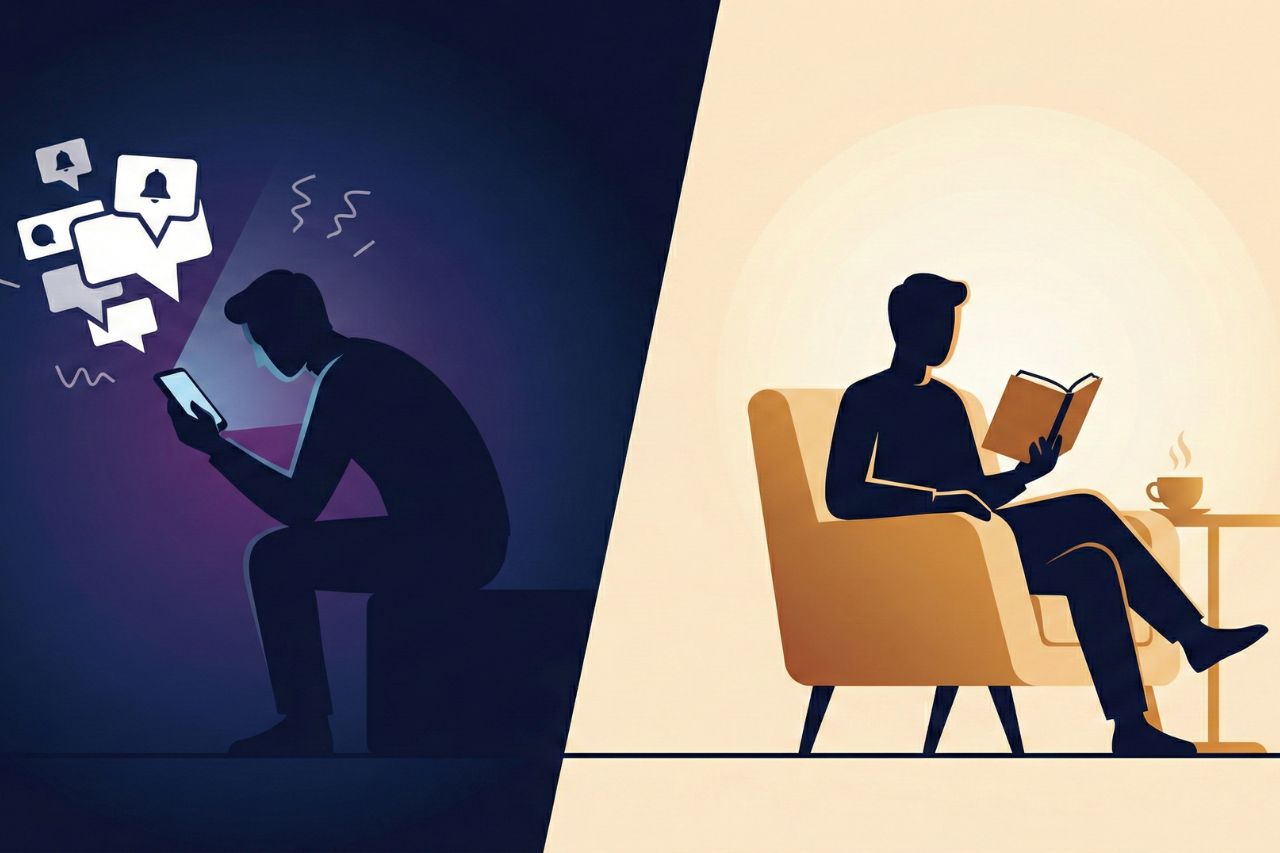
It’s Friday night. You are sitting on your couch in your pajamas. You are tired from a long week. You are perfectly comfortable.
Then, you pick up your phone.
You open Instagram. You see a story of your friends at a bar you didn’t go to. You see a coworker posting from a beach in Bali. You see a tweet about a breaking news story that everyone is outraged about.
Suddenly, your comfortable couch feels like a prison. The silence in your apartment feels like loneliness. You feel a knot in your stomach. Everyone else is living life, and I am just sitting here.
This is FOMO (The Fear of Missing Out). And in 2026, it is the primary engine driving our digital addiction.
But there is an antidote. It is a quiet, rebellious philosophy that is gaining traction among digital minimalists. It is called JOMO (The Joy of Missing Out).
Here is how to flip the switch in your brain from “Fear” to “Joy,” and why being disconnected is the ultimate luxury.
The Anatomy of FOMO: Why We Feel It
FOMO isn’t just jealousy; it is evolutionary.
Thousands of years ago, if you missed out on what the tribe was doing—a hunt, a migration, a gathering—you might die. Our brains are hardwired to be hyper-aware of what our peers are doing. Being “in the loop” meant survival.
Social media weaponizes this survival instinct. It provides a 24/7 live feed of everything you are not doing.
- The Highlight Reel: You compare your “Behind-the-Scenes” (your boring Tuesday night) with everyone else’s “Highlight Reel” (their vacation photos). It is an unfair comparison that you will always lose.
- The Urgency Trap: News apps and Twitter convince you that you must know everything the second it happens. If you don’t know the latest meme or scandal, you feel culturally irrelevant.
This constant scanning for information keeps us in a state of chronic, low-level anxiety.
Enter JOMO: The Art of Opting Out
JOMO is not about being a hermit. It is not about hating people.
JOMO is the emotionally intelligent realization that you cannot do everything, and that is okay.
It is the satisfaction of knowing that the cool party is happening right now, but choosing to stay home with a good book because that is what your soul actually needs. It is the relief of not knowing the latest Twitter drama.
JOMO is about Intentionality.
- FOMO says: “I have to check my phone so I don’t miss something.”
- JOMO says: “I am missing things on purpose so I can focus on what matters.”
How to Cultivate JOMO (A Practical Guide)
You cannot just “decide” to stop feeling FOMO. You have to train your brain to value your own time more than other people’s approval. Here are three steps to get there.
1. The “Ignorance is Bliss” Filter
We are drowning in information but starving for wisdom. Most “Breaking News” is noise that will be irrelevant in 24 hours.
The Fix: Curate your inputs ruthlessly.
- Unfollow news accounts that profit from outrage.
- Mute friends who treat Instagram like a competition.
- Embrace being the “last to know.” When someone says, “Did you hear about [X]?” practice saying with a smile: “No, I missed that. Tell me about it.” You will find that having a friend explain the news is far more social and less stressful than doom-scrolling it alone.
2. Trade “Watching” for “Doing”
FOMO thrives on passivity. When you are passively watching others live, you feel small. When you are actively creating your own life, you don’t care what others are doing.
The Fix:
Engage in Analog Hobbies. When you are deep in the flow state of painting, hiking, or cooking a complex meal, you physically cannot experience FOMO. You are too busy enjoying the reality in front of you. JOMO is the natural byproduct of Deep Work and Deep Play.
3. Define Your Own “Enough”
The internet is infinite. There is always another video, another article, another update. If your goal is to “keep up,” you will fail.
The Fix:
Set boundaries for “Enough.” Tell yourself: “I have read enough news for today.” “I have seen enough photos for today.” When you set a boundary (like turning on Focus Mode at 8 PM), you are declaring that your time is valuable.
The Luxury of Disconnection
In a world where everyone is hyper-connected, being unreachable is a status symbol.
Think about it: Who is constantly on their phone answering emails instantly? The employee. Who is hard to reach? The CEO.
Being disconnected implies that you are in control of your time. It implies that your current reality is so interesting that you don’t need to escape into a screen.
Missing Out is a Superpower
The next time you feel that twitch—that urge to check what everyone else is doing—pause.
Take a deep breath. Look around the room. Look at the way the light hits the floor. Listen to the hum of the fridge. Feel the weight of your body on the chair.
You are missing out on the drama. You are missing out on the noise. You are missing out on the stress.
But in exchange, you are gaining something far more valuable: You are getting your own life back.
Embrace the joy of missing out. It’s pretty nice over here in the quiet.