Is Your Phone an Adult Pacifier? The Science of Digital Coping

I want you to notice what happens the next time you feel a tiny spike of negative emotion.
Maybe you are standing alone at a party and feel a flash of social awkwardness. Maybe you are sitting at your desk and feel a wave of stress about a deadline. Maybe you are waiting for a friend who is five minutes late, and you feel a twinge of impatience.
What does your hand do?
Almost instinctively, it reaches for your pocket. You unlock your phone. You swipe.
You aren’t looking for information. You aren’t looking for entertainment. You are looking for Safety.
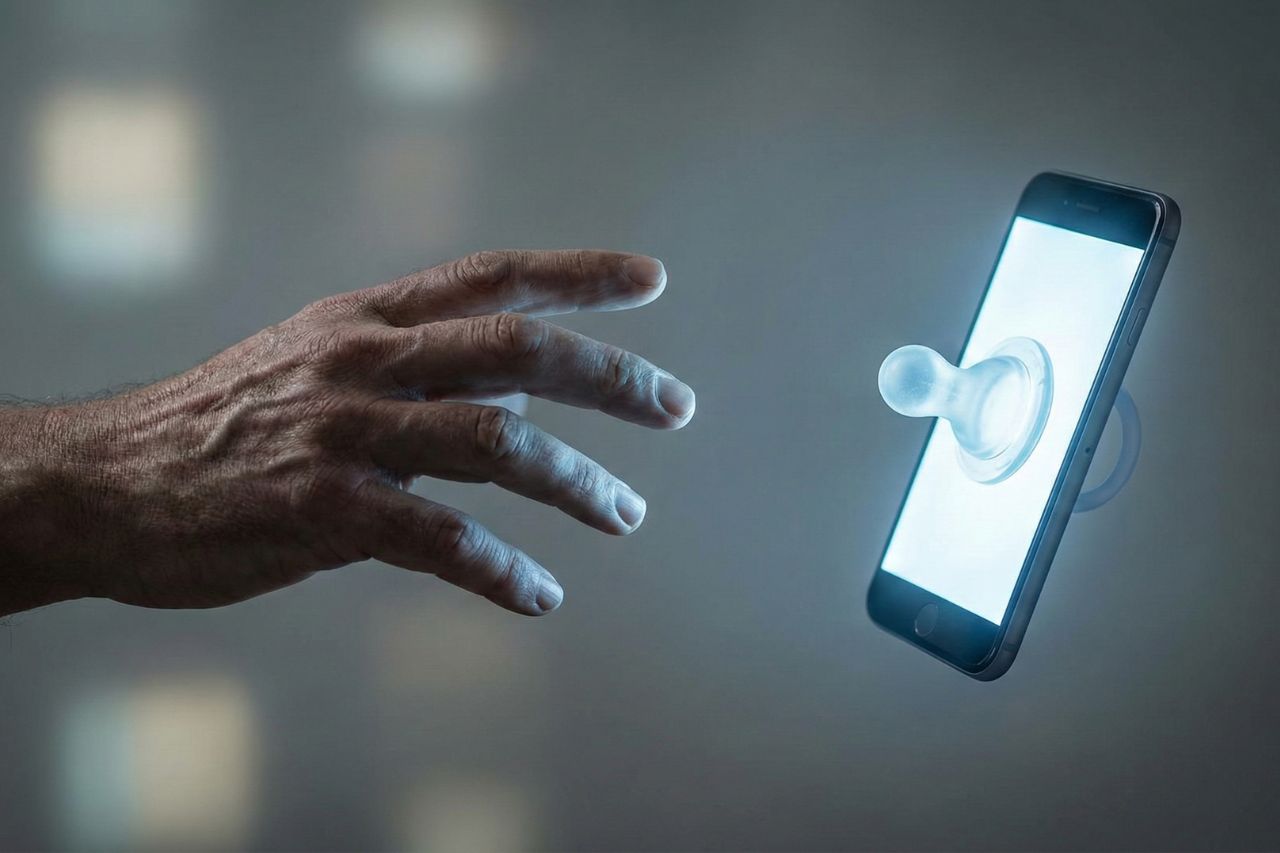
For toddlers, we give them a pacifier or a security blanket to soothe them when they are overwhelmed. For adults in 2026, we have the smartphone.
We have unwittingly trained ourselves to use a digital device to regulate our biological emotions. When we feel bad, we scroll to feel better.
But new research published in 2025 suggests that this habit is not just a harmless quirk. It is a psychological trap that is atrophying our ability to handle real life.
Hi, I’m Finn Albar.
We often talk about “addiction” in terms of dopamine and pleasure. But today, we need to talk about the darker side: using technology to numb pain.
Based on groundbreaking new studies, here is the science of “Digital Emotion Regulation”, and how to stop using your phone as an emotional crutch.
The Science of the Digital Safety Blanket
Why do we panic when our phone is not within arm’s reach? It turns out, the anxiety is not about missing a call. It is about losing our primary coping mechanism.
A massive qualitative study published in 2025 by Bar et al., which analyzed the impact of mobile phone bans in secondary schools, uncovered a startling reality.
The researchers found that students weren’t just using phones to chat or cheat. They were using them to survive emotionally.
“Many relied on their phones (e.g., using apps, ‘escaping’) to regulate mood, particularly anxiety and stress,” the study reports.
For many participants, the phone ban was traumatic not because they were bored, but because it “removed their primary tool or strategy for regulating emotion and handling distressing emotions”.
This isn’t just a “teenager problem.” It is a human problem. The study highlights a growing body of literature on “Digital Emotion Regulation,” suggesting that a significant portion of our screen time is dedicated solely to managing feelings like stress, sadness, and loneliness.
We are outsourcing our emotional regulation to a machine. Instead of taking a deep breath or processing the feeling, we bury it under a layer of pixels.
Cyberloafing as a Cry for Help
This behavior follows us into the workplace.
Have you ever found yourself “Cyberloafing”—mindlessly browsing the internet when you should be working? You probably chastised yourself for being lazy.
But a 2025 study by Nguyen et al. suggests you aren’t lazy; you are exhausted.
The researchers analyzed the drivers of cyberloafing and found a surprising correlation. Psychological Detachment and Relaxation were significant predictors of cyberloafing behavior.
The study utilizes the “Effort-Recovery Model,” which posits that individuals have limited psychological resources. When those resources are drained by stress, we instinctively seek recovery. “Employees… refresh their minds and more actively complete tasks” after a period of digital disconnection from work duties.
In this context, scrolling is a biological defense mechanism. It is your brain saying, “I am overwhelmed. I need to detach. Give me the pacifier.”
The problem is not the need for a break. The problem is the quality of the break. Scrolling social media is a “low-quality” recovery activity that often leaves us feeling more drained than before, creating a cycle of dependency.
The Trap of Experiential Avoidance
Using your phone to soothe anxiety works. That is why it is dangerous. It works too well, and it works too fast.
Psychologists call this Experiential Avoidance. It is the immediate escape from an unwanted internal experience (like boredom or anxiety).
By immediately escaping every negative emotion, we lose our Distress Tolerance.
- If you never sit with boredom, you lose the ability to be bored (leading to Popcorn Brain).
- If you never sit with social awkwardness, you lose your social confidence.
- If you never sit with stress, you lose your resilience.
The research warns that this “coping effect is relatively transient”. The relief is temporary. The anxiety always returns, often stronger, because the underlying cause was never addressed.
Signs You Are Using a Digital Pacifier
How do you know if you are using your phone as a tool or a crutch? Here are the symptoms identified in the 2025 data:
- The “Elevator Twitch”: You cannot stand in an elevator or a line for 30 seconds without checking your phone. The silence feels unsafe.
- The “Conflict Escape”: When you have an argument with a partner or receive a stressful email, you immediately open Instagram or a game to “numb out.”
- The Bedtime Doom-Scroll: You use the phone to “wind down” because you are afraid of the thoughts that come when your head hits the pillow. (Read more in our guide on Why You Can’t Sleep).
The Protocol How to Self-Soothe Without a Screen
We need to replace “Digital Coping” with “Analog Coping.” We need to reteach our bodies that we can survive an uncomfortable emotion without a glowing rectangle.
Here is a 3-step protocol to break the dependency.
Step 1: The “Pause” Breath
The next time you feel stress and your hand reaches for the phone, physically freeze. Don’t unlock it. Just hold it. Take one deep breath. Ask yourself: “Am I looking for information, or am I looking for relief?” If it is relief, put the phone down face down. Just for one minute. Prove to your brain that the feeling won’t kill you.
Step 2: High-Quality Detachment
The Nguyen study proved we need detachment to recover from work stress. But instead of cyberloafing, choose a high-quality recovery activity.
- Physical Movement: Stand up and stretch. Do 10 pushups. The change in physiology regulates emotion faster than Twitter.
- Nature: Look out a window at a tree or the sky. Soft fascination restores attention.
- The Silent Walk: As we discussed in our Silent Walking Guide, moving without audio input forces you to process your thoughts rather than drown them out.
Step 3: The Analog Anchor
If you need to keep your hands busy (fidgeting is a common anxiety response), give them something real to hold.
- Carry a small notebook to scribble in. Bullet Journaling allows you to externalize your stress onto paper.
- Wear a watch so you don’t check your phone for the time.
- Hold a hot drink. The warmth is biologically soothing.
Feeling is Healing
It is scary to be alone with your feelings.
It is scary to feel the full weight of a stressful day without the numbing agent of an algorithmic feed.
But that feeling is necessary. That feeling is data. It tells you what is wrong in your life so you can fix it. If you numb the check-engine light, the car will eventually break down.
Your phone is an incredible tool for communication, creativity, and knowledge. But it is a terrible therapist.
The next time the world feels too loud, don’t reach for the pacifier. Take a breath. Look the world in the eye. You are stronger than you think.
Further Reading

Bar, E., et al. (2025). "Student perspectives on banning mobile phones in South Australian secondary schools: A large-scale qualitative analysis." Published in Computers in Human Behavior. Read the study here

Nguyen, N. T., et al. (2025). "Misuse of technology: Factors influencing cyberloafing behavior." Published in Computers in Human Behavior Reports. Read the study here